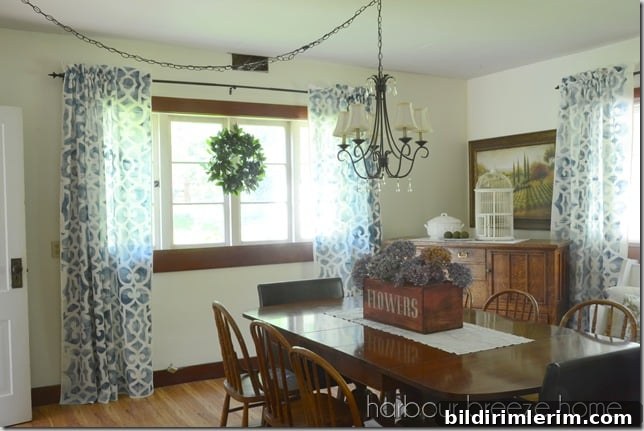
There was one decision in this dining room makeover that we debated for a long time. I almost hesitate to bring it up because I know some readers have very strong opinions about this kind of change.
Please withhold the hate mail — I understand your point.
What I love most about this room is its sense of history. The dark wood trim is original to the 1927 construction, and that historic character was part of the room’s appeal.
For a long time I loved the woodwork as it was, and my husband resisted changing it. I spent hours researching how to make dark wood trim work with our updated design, looking for examples of dining room makeovers that retained original trim while feeling fresh. In the end, I couldn’t find a way to make it feel right for the overall room.
It kept feeling like an outfit with an out-of-place belt — charming in theory, awkward in execution.
There was another practical reason we chose to paint the trim, and it came down to condition. Soon after we moved in, a friend toured the house with me and bluntly said, “Oh, but, it looks terrible!” We laughed, but she was right.
The trim wasn’t pristine; it was crackled, chipped, stained and overall dirty. The patina was real, but the surface condition meant it would take extensive work to restore it to an attractive stained finish.
I don’t do a lot of refinishing, but I’ve done enough to know that stripping, sanding, staining and sealing takes a lot of time, patience, and sometimes professional skill to achieve a beautiful result. Faced with that reality, we decided to paint the trim so the room could feel fresh and clean without an overwhelming amount of work.
Here are the steps we followed and some tips that helped the painted trim succeed in this historic dining room:
1. Remove or protect hardware. We removed all the hardware where possible, and for pieces that stayed attached we painted them while the windows and doors were open. Working when the weather cooperates makes ventilation and drying much easier.
2. Tape the panes. I carefully taped off all the glass panes to protect them during priming and painting.
3. Prime with an oil-based primer. This is very important. We used a Kilz oil-based cover primer to seal the old stain and prevent bleed-through. An oil-based primer creates a stable surface that allows subsequent latex topcoats to cover evenly and last longer.
Before priming, the trim showed wear and age. After priming, the surface was sealed and evened out, making it ready for the final finish.
{Before priming.}
{After priming.}
Once the oil-based primer cured, we applied a latex paint for the topcoat. The primer prevented the darker wood tones from bleeding through the latex paint — a mistake I learned to avoid the hard way after trying water-based primers on stained wood in the past. Using the correct undercoat is key when covering dark-stained wood with lighter paint.
A few practical tips from this project:
– Use disposable brushes or inexpensive brushes for oil-based products. Cleaning brushes used with oil-based primers requires strong solvents; I prefer to use cheap brushes and discard them rather than deal with solvent cleanup.
– Work in good weather when you can open doors and windows for ventilation and faster drying times.
– Remove hardware when possible and label pieces so reinstallation is straightforward. If hardware can’t be removed, paint carefully around it or mask it off.
– Take time to sand any rough or flaking areas before priming for a smoother finish.
Painting the original trim was a difficult decision because we wanted to respect the home’s history while creating a bright, cohesive dining space. In our case, painting allowed the room’s architectural details to be preserved visually while improving condition, cleanliness, and overall harmony with the updated décor.
The result is a dining room that maintains its historic bones but reads as refreshed and welcoming — a balance between honoring the past and making the space livable for today.