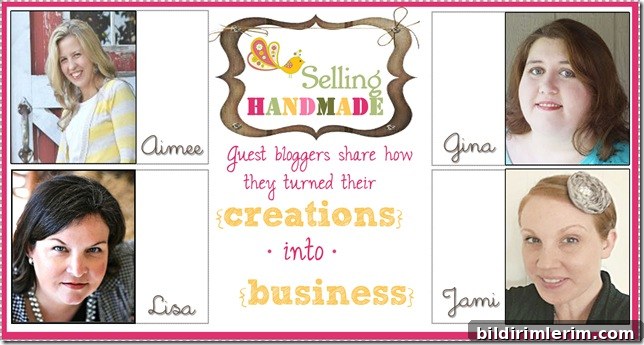
Happy Monday! After a short weekend break, our mini-series continues. Over the past week I’ve asked four guest bloggers to share the practical details of selling handmade creations online. If you missed earlier posts, you can start at the beginning of the series.
My Etsy shop grew out of this blog. One of my craft projects picked up momentum on Pinterest, and soon I started receiving requests for hand-painted signs. That’s how things often unfold—a project gains traction, interest grows, and a new opportunity appears. Exciting, but sometimes overwhelming.
For me the most overwhelming part has been promoting the shop across the many social channels—Pinterest, RSS, email, Twitter, Facebook, StumbleUpon, and more. The constant pinning, tweeting, sharing and liking can feel endless. I asked our four guest bloggers how they handle promotion and where they draw the line with social media.
Day 6: Promoting Your Shop — Getting the Word Out
Question: I have to be honest — I’m totally overwhelmed by all the promotion and social media options (Pinterest, RSS, email, Twitter, StumbleUpon, Facebook, etc.). How do you promote your Etsy shop without losing your mind? Where do you draw the line?
Gina, from The Shabby Creek Cottage
Confession: I have help managing social media. My priority is consistently producing quality blog content—when people read the posts, they discover my shop and often follow through. I don’t personally spend a lot of time pinning, tweeting, or reposting items; my assistant maintains Pinterest and Facebook on behalf of the blog, which frees up my time for creating and interacting with readers.
Having help allowed me to focus on what I enjoy most—responding to comments and connecting with followers—while delegating the daily posting tasks that can quickly consume a day. If hiring help isn’t feasible, consider prioritizing one or two platforms and keeping the rest minimal.
Jami from Freckled Laundry
I still feel overwhelmed by social media sometimes and find Gina’s approach inspiring. Right now my pace is intentionally steady—I let my blog be the primary voice for my shop, and I share new listings and promotions through Facebook, which I’ve connected to automatically post to Twitter. That automation can save a lot of time.
Etsy also gives you the option to share new listings directly to social accounts when you upload them, so one or two clicks will broadcast your new items. Don’t hesitate to ask friends and family to like or share posts—word of mouth on social platforms is the modern equivalent of handing out business cards.
Blog collaborations and giveaways can also drive traffic. I’ve sent products to bloggers who then wrote features and linked back, and those posts generated meaningful visits and sales. I’m still learning Pinterest and StumbleUpon—others pin or stumble my items and that brings visitors, even when I don’t do the pinning myself.
Email newsletters are a powerful marketing tool I plan to use more in the future, especially when I reopen my shop after developing a signature line of textiles and handcrafted tags. When the time comes I’ll prioritize newsletters and Pinterest, and I’ll likely recruit an intern to help with the workload.
Hiring an intern can be a practical solution for growing shops. Students often seek creative internships, and an assistant can help with packaging, order processing, labeling, and other tasks that otherwise take you away from making and promoting products. If you prefer personal control, take small steps—delegate what you can while keeping the parts you love.
In short: stick with what you can manage, be consistent with your blog or chosen platforms, and scale up your social engagement only as your time and resources allow. The more you engage, the more visibility you’ll gain, but balance is essential.
Lisa from The Pennington Point
I’ll admit I’ve felt like I’ve lost my mind at times too. I primarily use Twitter, Pinterest and my blog to market products. One strategy that helped my business grow was asking a larger blogger to review a new item. I sent a sample, she featured it with a photo, and that exposure delivered orders and momentum. That early boost helped me develop additional products and grow at a steady pace. If you’re starting out, targeted outreach to bloggers and well-planned collaborations can be more effective than spreading yourself thin across every social network.
Aimee from My Pink Life
Pinterest has been the biggest source of traffic to my shop. Right now I haven’t needed to maintain separate shop accounts on Twitter or Facebook—my blog and Pinterest have provided most of the visibility I need. For many handmade sellers, Pinterest images that resonate can drive consistent referral traffic without heavy daily maintenance on multiple networks.
Reading these answers was a relief—I’m glad I’m not alone in feeling overwhelmed by social media. The main takeaway for me is to focus on what I can handle consistently and not try to conquer every platform at once.
Thanks, Lisa, for sharing how your shop found momentum. It’s encouraging to hear practical examples of growth that started slowly and built over time.
Tomorrow we’ll wrap up the series with one final topic that ties into today’s theme: finding balance in our busy lives. Is it possible? Join us and find out.