What I’m about to share falls squarely into the “quite humiliating” category — also the “silly tourist” and “thankfully I didn’t die” categories. I could have left this episode out of my Maui Memories series, but my husband and I thought the story might help someone else who plans to visit Maui.
Before our trip we read a lot about the island, but nobody covered this particular hazard in detail.
Yesterday’s post described our upcountry drive to Haleakala Crater. By the time we descended from the mountain it was late afternoon — around 4:00–4:45 pm — and full of energy, eager to find a beach and swim.
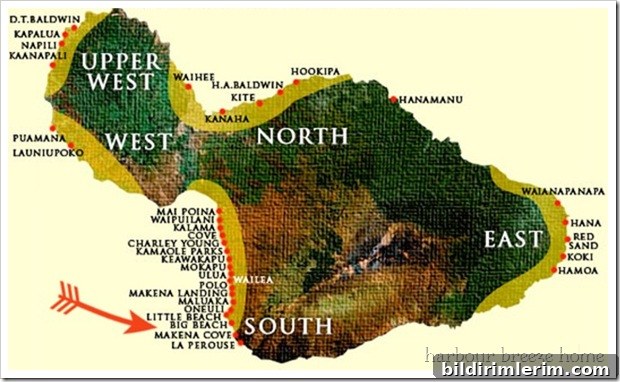
As the map below shows, Maui has dozens of beaches to choose from.
We consulted our Fodor’s guide for recommendations. His top pick in 2008 was Big Beach, which sounded pristine and inviting. We drove past several smaller coves before finally reaching Big Beach. The parking lot was neither full nor empty.
Walking the wide, tree-lined sandy path toward the shore, we passed a young man carrying a large boogie board. The first thing that caught my eye was a lifeguard stand. The sign posted on it said the lifeguard went off duty at 4:30, so it was empty. There were also warning signs — the same kinds posted at many beaches — describing strong shorebreak conditions.
At the time, I didn’t fully understand what those warnings meant.
We picked a spot and set our things down. To one side was a relaxed couple on towels, beyond them a family with small children playing in the surf. On the other side of us was the boogie-boarder — a hint, in retrospect — and further down a couple floating chest-deep in much gentler water.
I felt uneasy. The waves directly in front of us looked far stronger than those where the other couple was floating. My husband waded in and floated calmly as the swells carried him up and down.
“Come on,” he encouraged. “Just walk out a bit farther and you’ll be fine.”
I didn’t want to be the nervous tourist, so I headed into the water tentatively. Before I could get very far, a wave knocked me to my knees and drenched me. We laughed it off, and I tried again.
Then a larger wave appeared. I turned my back — a mistake — and saw from the corner of my eye a wall of water rising. It was easily a foot higher than my six-foot husband’s head. I remembered an old tip about jumping when a wave breaks. I jumped, landed, and the wave slammed my face into the sand, dragging my body up onto the shore.
It sounds funny now, but in the moment I was terrified — more scared than I was during a rollover car accident I’d survived years earlier. My swimsuit collected several cups of sand; that was the only small consolation.
I wasn’t able to recover my nerve that day. I trembled and could not watch my husband stay out in that surf, so he came back in and we left. Our first beach experience in Maui was short and unsettling.
Two days later, while telling the story to our snorkeling guide, he grew serious. “That’s not funny,” he said. “That’s one of the most dangerous beaches here. We call it ‘Break Neck Beach.’ People break their necks there.” A little online research afterwards confirmed that Big Beach is known for strong shorebreaks and powerful waves, especially near the shoreline where the ocean drops off suddenly.
I don’t tell you this to frighten you away from Big Beach — it’s absolutely worth visiting; it’s beautiful. My point is that choosing the right spot along a beach is crucial for safe swimming. Watch the waves for a while from shore. If the sand shows a deep, abrupt cut or the water is breaking very close to shore, those are signs of dangerous shorebreak. Those conditions are better suited for experienced surfers and bodysurfers, not casual floaters or families with small children.
If you return to Maui, ask locals for specific advice about safe swimming areas. Lifeguards and residents know where the rip currents and shorebreaks concentrate and can point you to calmer spots.
We don’t have photos of our Big Beach experience — we left the cameras locked in the car that day — but we did get a happier last morning at Kaanapali Beach, which became our favorite. There we found a gentle spot and spent our time bobbing in the waves and watching clouds drift by, with no terrifying close calls.
More posts from our Hawaii trip
-
-
- Over the Rainbow
- The First Glimpse | Flying into Maui
- Visiting Upcountry Maui
- Kaanapali Beach and Eating Hula Pie
- Snorkel Trip to Molokini Crater and Discovering New Beaches
- Day Trip to Honolulu and Waikiki Beach
- The Road to Hana
- Things to Note when Traveling to Hawaii + The Highlight Reel Video
-